
Prior authorization in Minnesota: stop eating denials
Nothing stings like a denial for a session your counselor already showed up for.
Does the 2026 Minnesota law end prior authorization for outpatient mental health?
Quick answer: Starting January 1, 2026, Minnesota law bars prior authorization for outpatient mental health & substance use disorder treatment (medications excluded) in state-regulated health plans. The catch: state-regulated plans are roughly 40% of the Minnesota market.
For Minnesota behavioral health directors, that gap is the whole job.
Self-insured employer plans & Medicare follow other rules, and Minnesota Health Care Programs still lists authorization requirements for several mental health services. So you still need a tracker.
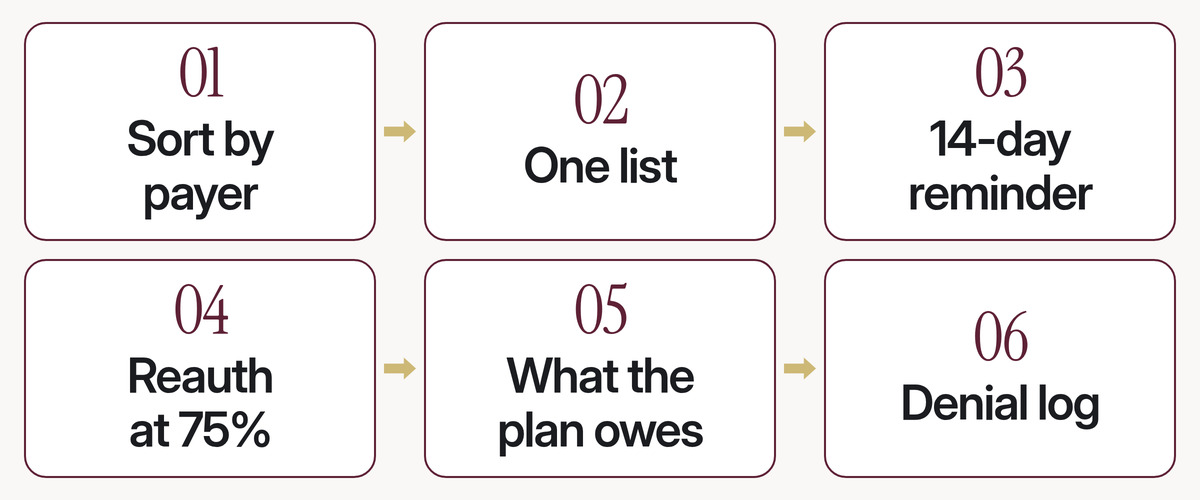
Sort every client by who regulates their plan, put every active authorization on one list, set a reminder 14 days before each end date, name an owner, update units every Friday, and start the reauthorization at 75% of units.
TL;DR
- The 2026 Minnesota law took outpatient mental health & SUD treatment off the prior auth list for state-regulated plans only.
- Self-insured employer plans (about 35% of the market) and Medicare (about 19%) sit outside that law.
- MHCP still requires authorization for some services, such as ARMHS above benefit limits, DBT and TMS. Requests go through Acentra Health.
- Federal rules now give Medicare Advantage & Medicaid plans 7 calendar days for standard decisions and 72 hours for expedited ones, with a specific reason on every denial.
- Your tracker needs 5 columns: payer type, units approved, units used, end date and owner.
- Reminders go out 14 days before the end date. Reauthorization starts at 75% of units.
- Keep a denial log. Minnesota's own medical association says the law is only as effective as the complaints regulators receive.
Key takeaway: The 2026 law only covers state-regulated plans. You still need a tracker, with someone's name on every row.
Jump to a step:
- Sort your caseload by who regulates the plan
- Put every active authorization on one list
- Set a reminder 14 days out and put a name on it
- Update units every Friday and start the reauth at 75%
- What does the plan owe you after a denial?
- Keep a denial log and use it
Reflect before you build anything
Reflect today: If your billing lead won the lottery tonight and never came back, could anyone on your team list every authorization that ends this month?
If the answer involves the phrase "I think it's in her inbox," keep reading.
Prompt to paste: Use de-identified data only, and only in a tool covered by a business associate agreement.
I run a behavioral health program in Minnesota.
Below is a de-identified list of our active authorizations with these columns: payer type (state-regulated, self-insured, Medicare, MHCP fee-for-service), units approved, units used, end date, owner.
Flag every row that ends in the next 30 days or has used more than 75% of its units. Sort by urgency.
Then write a 1-page Friday checklist for the owner of each flagged row. [paste list]
Step 1: Sort your caseload by who regulates the plan
Real talk: Most denial problems start with someone assuming every plan follows the same rules. They don't, and the insurance card won't volunteer it.
The 2026 law only protects you where state law reaches. That makes payer type the first column on your tracker, before anything else.
- State-regulated: fully insured employer plans, Medical Assistance & MinnesotaCare (fee-for-service & managed care), MNsure plans and the state employee plan.
- Not state-regulated: self-insured employer plans (federal ERISA rules) and Medicare, including Medicare Advantage.
- How to tell: check the card, ask the client where the coverage comes from, or call the plan. The Minnesota Medical Association's guide suggests exactly that, in that order.
- Write it down once. Payer type goes in the record at intake so nobody re-guesses it at billing.
Example (sample data)
A client with coverage through a large self-insured employer starts residential care. The 2026 outpatient protections don't apply to that plan, so the authorization goes on the tracker on day one.
Step 2: Put every active authorization on one list
Real talk: 6 sticky notes and a shared inbox do not count as a list, no matter how organized the sticky notes are.
One list for the whole program. Every client with an active authorization, from every payer, in one place.
- Use 5 columns: payer type, units approved, units used, end date, owner.
- Keep 1 row per authorization so a client with 2 services gets 2 rows.
- Store it somewhere your team already opens daily, such as your EHR report or a shared sheet with access controls.
- Keep PHI out of email and out of any AI tool without a business associate agreement.
Example (sample data)
| Payer type | Units approved | Units used | End date | Owner |
|---|---|---|---|---|
| [Payer A], MHCP FFS | 20 | 12 | Dec 18 | [Name] |
| [Payer B], self-insured | 12 | 11 | Nov 30 | [Name] |
| [Payer C], Medicare Advantage | 24 | 6 | Feb 2 | [Name] |
Row 2 is the one that ruins your December.
Step 3: Set a reminder 14 days out and put a name on it
Real talk: A reminder assigned to "the team" is a reminder assigned to nobody, with extra steps.

14 days gives the plan its full decision window and leaves you a few days for the inevitable "please resend page 4."
- Set the reminder 14 days before every end date, inside the tool you already use.
- Put one person's name on each reminder. One name, with a backup listed for vacations.
- Federal rules give Medicare Advantage & Medicaid plans up to 7 calendar days for a standard decision, and they can take up to 14 more days in some cases. Plan for the long version.
- MHCP's provider manual says documentation older than 4-6 months usually won't count as timely for most authorizations, so pull fresh documentation when the reminder fires.
Example (sample data)
The [Payer B] authorization ends Nov 30. The reminder fires Nov 16 and goes to [Name], who requests updated documentation from the clinician that day.
Step 4: Update units every Friday and start the reauth at 75%
Real talk: Units run out quietly, usually on a Tuesday, and nobody sends a calendar invite.
- Pull units used from the same report every Friday, so the numbers match week to week.
- Flag any row at 75% of units approved.
- Start the reauthorization request when a row hits 75%, even if the end date is weeks away.
- For MHCP services, submit through Acentra Health's Atrezzo portal, which DHS lists as the preferred route.
Example (sample data)
[Payer B] shows 11 of 12 units used. That's 92%, so it should have started 2 Fridays ago.
Start it today and note why it slipped.
Step 5: What does the plan owe you after a denial?
Real talk: Plans have rules too. They just don't put them on the welcome packet.
For state-regulated plans, the Minnesota Medical Association's guide to the law summarizes 4 protections worth knowing:
- An approval for a chronic condition does not expire unless the standard of treatment changes.
- When a client switches to a new plan that uses a different review company, the new plan must honor active approvals for the first 60 days, as long as you send documentation of the prior approval.
- A plan cannot deny a completed service solely for missing prior authorization if the service would have been approved.
- Plans must post their prior auth requirements publicly and give in-network providers 45 days' notice of changes.
For Medicare Advantage & Medicaid plans, CMS requires a specific reason on every prior auth denial. Read it, because it tells you exactly what to fix on resubmission.
Step 6: Keep a denial log and use it
Real talk: Complaining in the break room has never once overturned a denial.
- Log every denial: date, payer type, service, reason given and outcome.
- Review the log monthly with your billing lead.
- When a state-regulated plan breaks the rules, file a complaint. Medical Assistance & MinnesotaCare issues go to DHS, HMO issues go to the Minnesota Department of Health, and the Department of Commerce will route you if you're unsure.
- The Minnesota Medical Association puts it plainly: regulators can only act on noncompliance they hear about.
Reality check: Prior auth still lives in your building after January 1, 2026. Self-insured plans, Medicare and several MHCP services still need tracking, and the only thing standing between you and a denial is a list somebody actually opens. A plain spreadsheet with an owner will do the job.
Pro tip: Ask your billing lead one question this week: "What share of our claims come from self-insured employer plans?" That number tells you how much of your caseload the 2026 law skipped.
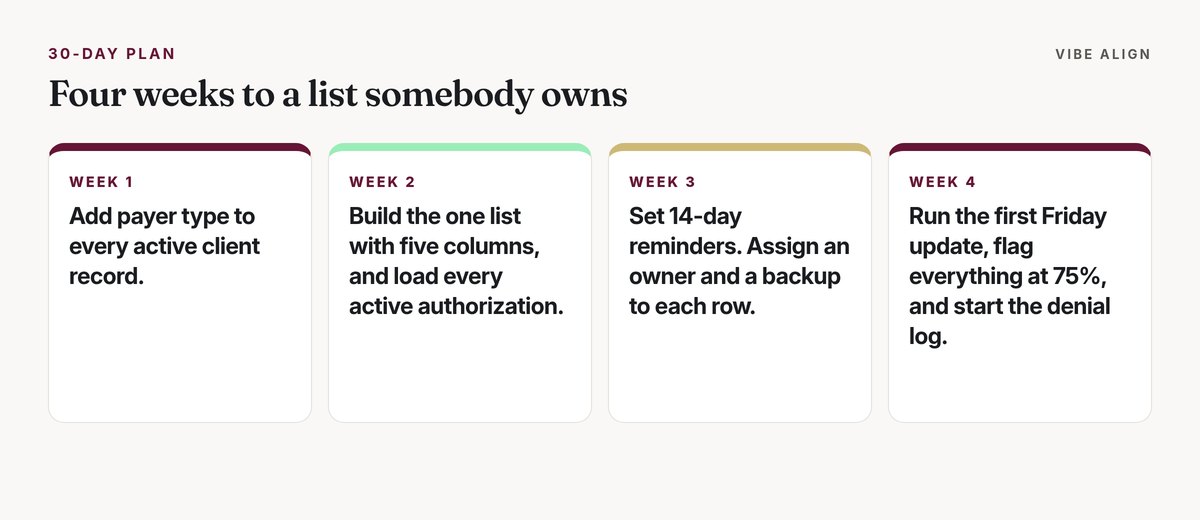
Your 30-day plan
Four weeks, one move a week.
Frequently asked questions
Does the 2026 Minnesota law end prior authorization for outpatient mental health?
Starting January 1, 2026, Minnesota law bars prior authorization for outpatient mental health and substance use disorder treatment, except medications, in state-regulated health plans. That is roughly 40% of the Minnesota market. Self-insured employer plans and Medicare follow other rules, and Minnesota Health Care Programs still lists authorization requirements for several mental health services. You still need a tracker.
Which Minnesota plans are still outside the 2026 prior authorization ban?
Self-insured employer plans (about 35% of the market) and Medicare, including Medicare Advantage (about 19%), sit outside that law. State-regulated plans include fully insured employer plans, Medical Assistance and MinnesotaCare, MNsure plans, and the state employee plan.
Do Minnesota Health Care Programs still require authorization?
Yes. MHCP still requires authorization for some services, such as ARMHS above benefit limits, DBT, and TMS. Requests go through Acentra Health.
When should a behavioral health program start a reauthorization?
Set a reminder 14 days before every end date, and start the reauthorization when 75% of approved units are used. Federal rules give Medicare Advantage and Medicaid plans up to 7 calendar days for a standard decision, and they can take up to 14 more days in some cases.
What belongs on a prior authorization tracker?
One list for the whole program, with five columns: payer type, units approved, units used, end date, and owner. One row per authorization, and one person's name on each reminder.
Want help setting this up?
Vibe Align provides access and support so your team can put a tracker, reminders, and a Friday report on the systems you already use. Authorizations stop expiring quietly when someone on your staff owns the list.
Start here: vibealign.co
Sources
- Minnesota Statutes 2026, section 62M.07, subd. 2 (prior authorization prohibited for outpatient mental health & SUD treatment, excluding medications, effective January 1, 2026, for plans offered, sold, issued or renewed on or after that date). https://www.revisor.mn.gov/statutes/2026/cite/62M.07
- Minnesota Medical Association, "Physicians' Guide to Minnesota's Prior Authorization Law" (updated January 2026). Covers the state-regulated product table and market shares, how to identify product type, chronic condition approvals, 60-day continuity, coverage without PA, posting and 45-day notice, and complaint routing. https://www.mnmed.org/application/files/1817/6581/7145/MMA-PA-Guide.pdf
- Minnesota Medical Association, Prior Authorization page ("roughly 40% of the Minnesota market"). https://www.mnmed.org/advocacy/key-initiatives/prior-authorization
- CMS, Improving Prior Authorization Processes FAQ (CMS-0057-F: 72 hours expedited, 7 calendar days standard, extensions up to 14 calendar days, calendar time). https://www.cms.gov/initiatives/burden-reduction/overview/interoperability/frequently-asked-questions/improving-prior-authorization-processes
- CMS press release on CMS-0057-F (specific reason required for denials). https://www.cms.gov/newsroom/press-releases/cms-finalizes-rule-expand-access-health-information-improve-prior-authorization-process
- MHCP Provider Manual, Authorization (Acentra Health as review agent, Atrezzo portal preferred, documentation older than 4-6 months generally not timely; revised July 31, 2026). https://www.dhs.state.mn.us/main/idcplg?IdcService=GET_DYNAMIC_CONVERSION&RevisionSelectionMethod=LatestReleased&dDocName=id_008925
- Acentra Health, Minnesota MHCP Mental Health (authorization forms for CTSS, ARMHS, DBT, TMS and extended psychiatric inpatient). https://mhcp.acentra.com/mental-health/
- MHCP Provider Manual, ARMHS (authorization for services exceeding benefit limits). https://www.dhs.state.mn.us/main/idcplg?IdcService=GET_DYNAMIC_CONVERSION&RevisionSelectionMethod=LatestReleased&dDocName=ID_058153
Not legal or billing advice. Example data is labeled and uses placeholders.
